

No Agendy? No Attendy!
A full calendar does not make you a leader.

A helpful manager’s presence is a scarce resource.
If you spend it sitting silently in low-value meetings, you are not “staying aligned.” You are taking your judgment, problem-solving, decision-making, and emotional-regulation meat suit away from the people who are your primary responsibility and who actually need it.
Welcome back folks to Dan’s hot takes. In this essay I will be roasting all managers who go to all the meetings they are invited to.
If that’s you… know that I understand performative meeting culture is not entirely your fault. Most organizations reward calendar gravity and call it leadership. I understand how good it feels to be needed and to go to meetings and feel like you’re having an impact.
This essay is for you. I hope it finds you. It’s also for the managers who go to lots of meetings and don’t know how to feel about it yet.
Before the color coded agenda people start lighting torches: yes, some meetings matter. We’ll get there.
I waste a lot of time in meetings. You waste a lot of time in meetings. We all waste a phenomenal amount of time in meetings.
And most meetings don’t do shit for your team.

Your actual job.
As a manager, you’re a leader who’s responsible for discrete business outcomes. Actual work. Things getting better, safer, faster, easier, more done, less on fire.
You have resources. A team, cash money budget, and time. Your job is to leverage those resources to orchestrate value for the customer and/or the organization.
You also have some innate responsibilities that come with the role of having people in your charge:
Keep your people safe physically and psychologically.
Solve the problems your team cannot solve yet.
Pull resources from the organization to keep your team properly leveraged.
Stay emotionally regulated when work starts turning into a fiery raccoon tornado.
Okay so there’s your job description. In a sentence?
Be there for your folks and get work done.
Meetings aren’t in your job description
There is nothing in there about going to meetings.
In fact, going to meetings makes you worse at getting your job done.
You’re not in your office available for your team.
You’re not on the floor staying aware of what’s going on.
Problems have to wait for you to be available.
People aren’t able to go to you when they need you.
You’re slow to respond during emergencies.
So why go? Optics? Is your big ol’ boss expecting you there? Do you think that meeting that you didn’t prepare anything for and you’re just going to be a warm body in, where you’re expected not to raise objections, is advancing the institutional goals and objectives?
AAAAaaaaaa. False, my homie.
Your team definitely notices that you’re in meetings all day.
Your team does not experience your full calendar as leadership. They experience it as latency.
If you were available for them when they needed you and you got their problems solved and their needs met as soon as they had them, you would be their superhero.
This. Is management.
Management isn’t being in meetings.
Management is being a lethal weapon problem solver extraordinaire who gets mega shit done and teaches their team to do the same.
Every meeting attended has an opportunity cost. The cost is not just your time. The cost is your team’s access to you.
Now,
If you share my leadership philosophy, your purpose as a leader is…
to not be needed.
Meetings are side-quest generation machines.
Going to meetings gets you work assignments that don’t benefit your people.
I’m not saying don’t be a team player, but you should have a boundary on what you take on and don’t because your #1 priority is the safety and wellbeing of your squad.
Period.
Side quests are for the backlog, and we hire people to go do those, not our highly trained managers who are supposed to be investing in their squad.
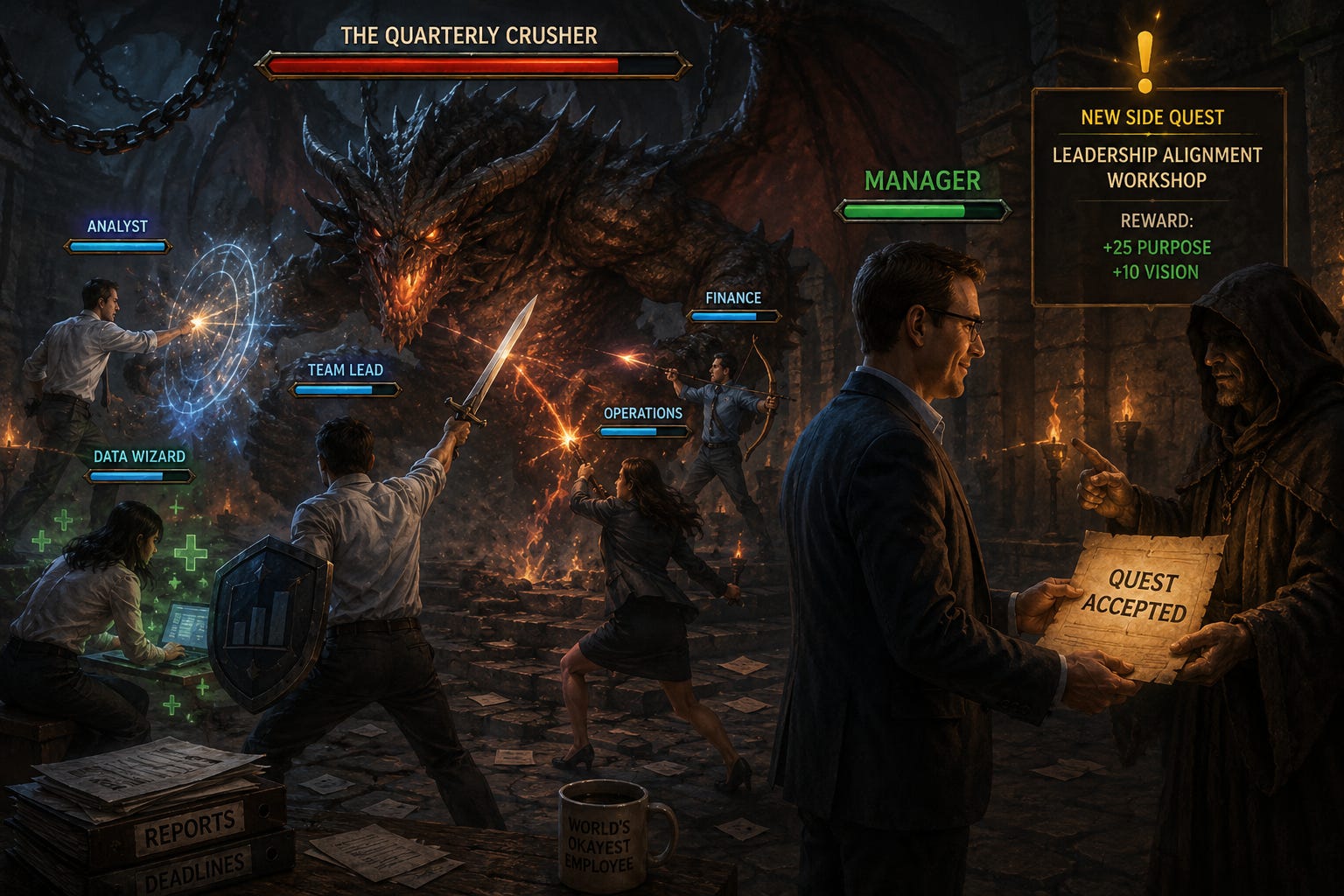
The Leadership Management Paradox
You’re saying I’m needed and I’m not there but my goal is to not be needed…. So… WTF Dan, how are both true?
Well,
It takes time and intentional training of your people to not be needed.
And 97.3% of teams aren’t there yet. And when they are, we promote, disperse our talent, and get new folks. This work is never done when you do it right.
When we put the two together, be there and not be needed, you’re not freeing your calendar because you’re going to solve all your team’s problems for them like a babysitter.
You’re becoming available to support and mentor your team so they can grow as individuals and solve problems for themselves without you.
So if/when you’re not around, they execute at the highest level.
The Challenge
If you’re sitting there thinking, “Well Daniel… I HAVE to go to all these meetings. And you just don’t get it. And my team is great and I didn’t have to train them. They just don’t need me.”
Yeah… sure buddy. Let’s try something together.
For one week, skip, delegate, shorten, or ask for notes from every meeting that does not need you for a decision, blocker, risk, relationship, or representation function.
Then spend the recovered time on the floor, in your team’s work, removing blockers, coaching people, and finding the problems that have been waiting for you to be available.
If your team comes back after that week and says, in writing, “This provided no value and did not help us get closer to our deliverables,” I will personally Venmo you $100 and write an apology blog saying I was wrong and I’m a big dumb idiot.
Go ahead. Try it. Try one full week of fewer meetings and more direct team support.
One other small point real quick:
A helpful manager’s presence is a scarce resource. If you spend it sitting silently in low-value meetings, you are stealing it from your team.
Practical Better Awesomer Options For UnFu*king Your Calendar
The goal is not to never attend meetings. The goal is to stop donating your presence to rooms where you are not meaningfully changing important business outcomes.
Send someone on your team.
This is called delegation. Sound it out with me: Del-E-Gat-Ion.
Why it works: The person closest to the work has better answers than you do. They will learn more from being in the room than you will.
How to do it: teach them how to take notes, make quick decisions inside a defined boundary, and bring back the three things you actually need to know.
Never have two leaders from the same team in the same meeting.
If you’re all in the same place at the same time, you’re wasting your time. If I walk into a meeting and see my boss or my colleague there, I ask them if they’re good, then leave.
Why it Works: Distributing your span of influence allows you to be there for your people AND have leadership presence in the meeting. By taking turns you’re cutting down the bullshit by however many managers are in your leadership rotation.
How to do it: One a month review your calendars and ensure you’re covering your bases. Make rules on who goes to what. Stick to those rules. Then if you walk into a meeting and one of your team is there. Figure out in 20 seconds who needs to be there and then stay/leave.
No Agendy No Attendy.
I don’t go to meetings that don’t have agendas. They are typically unstructured and inefficient.
Why it works: If I don’t know what it’s for and why I need to be there, I’m just going for the fun of it and that’s a useless waste of time.
How to do it: It is not rude to send a 2-minute email to someone asking, “Hey, I saw this meeting and want to know what it’s about so I can prioritize being there if you need me in particular. I’ll take a rough agenda if you have it.”
You aren’t being a pain in the ass, you’re cross-coaching for organizational results and efficiency.
You’re cross-coaching others to become better leaders.
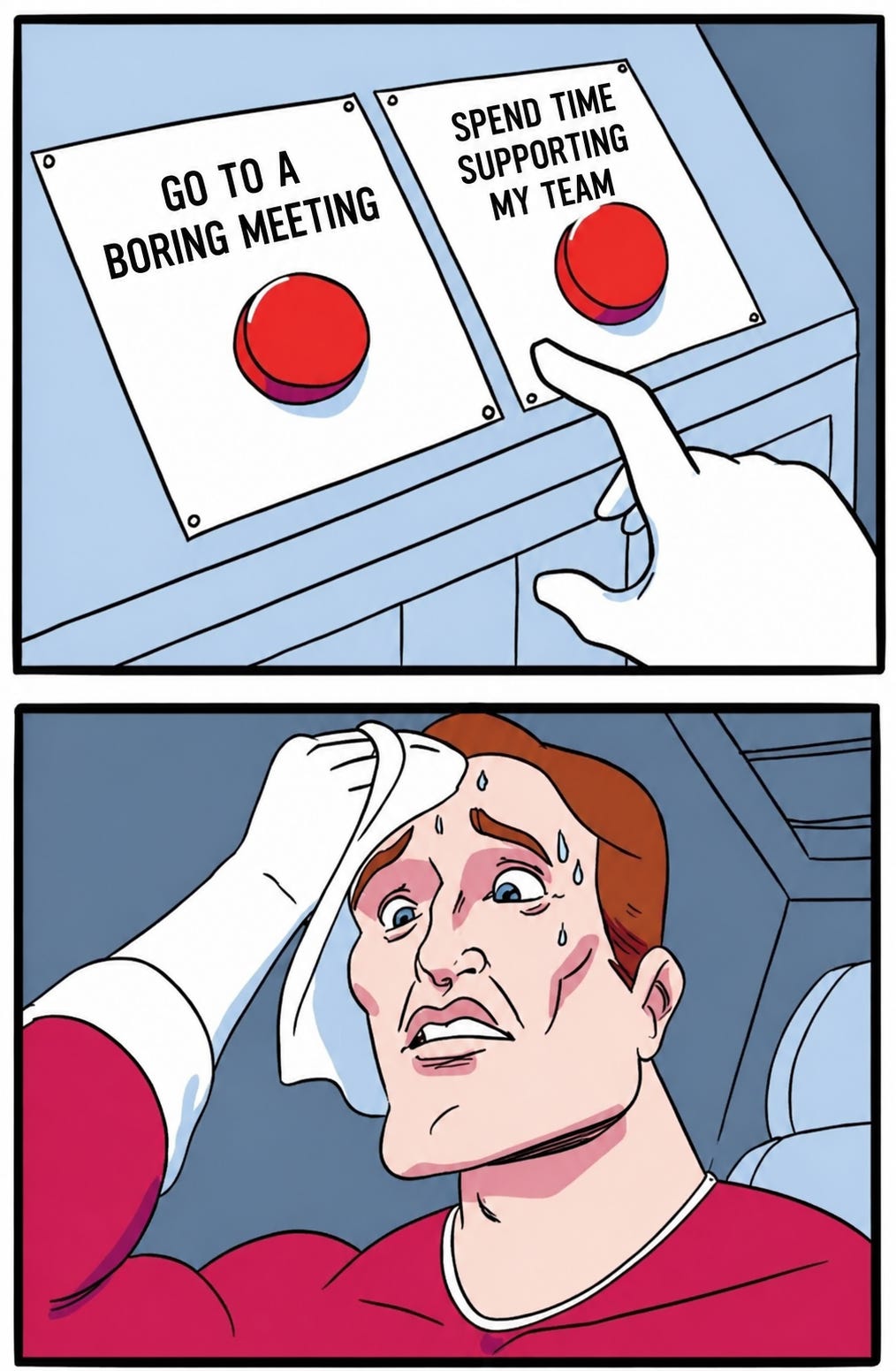
Block out your deep work and your manager floor time.
Block out a few hours every day for you to get your work done. No scheduling over that time unless it’s an emergency.
Why it works: Guess what!? You’re not the most important person in the office. And when you decline, they will probably have the meeting without you and be just fine. You are not needed there. But your people DO need you.
How to do it:
Block out your floor walks. It’s a meeting just for you.
Block out your office hours. Interruptible deep work.
Decline everything that gets scheduled over those times. And watch the magic happen.
Some meetings are valuable, necessary, and worth your time.
Go when you are needed for a decision, a blocker, a risk, a relationship, or a strong representation function.
Why it works: This will help you keep your job.
How to do it: When do meet, be the best. Agenda - on lock. Key stakeholders - locked in.
The how to is in a separate essay where I provided some absolutely bangin’ tips on how to make your meetings more productive.
Want to control meeting outcomes? Want to be the top G in meetings?
You’re one click away from my advanced bloodline technique meeting jutsu of professional success. Domain expansion: corporate excellence.

If anyone gets upset with you send them this article and tell them Dan wanted to have a word. I will back you up 1000% percent. Just like,… a good manager would. See what I did there?
Have a great week,
-Dan
References
(reach out if you have questions about these)
Barends, Eric, et al. Productive Meetings: An Evidence Review. London: Chartered Institute of Personnel and Development, 2023.
Deci, Edward L., Anja H. Olafsen, and Richard M. Ryan. “Self-Determination Theory in Work Organizations: The State of a Science.” Annual Review of Organizational Psychology and Organizational Behavior 4 (2017): 19-43.
Drucker, Peter F. The Effective Executive. New York: Harper & Row, 1967.
Edmondson, Amy C. “Psychological Safety and Learning Behavior in Work Teams.” Administrative Science Quarterly 44, no. 2 (1999): 350-383.
Hackman, J. Richard. Leading Teams: Setting the Stage for Great Performances. Boston: Harvard Business School Press, 2002.
Lehmann-Willenbrock, Nale, Steven G. Rogelberg, Joseph A. Allen, and John E. Kello. “The Critical Importance of Meetings to Leader and Organizational Success: Evidence-Based Insights and Implications for Key Stakeholders.” Organizational Dynamics 47, no. 1 (2018): 32-36.
Rogelberg, Steven G., Joseph A. Allen, Patrick Shanock, Cliff Scott, and Marissa Shuffler. “Employee Satisfaction with Meetings: A Contemporary Facet of Job Satisfaction.” Human Resource Management 49, no. 2 (2010): 149-172.

This resonated with me.
One thing I’ve noticed is that organisations often subconsciously reward attendance more than outcomes. As a manager, when I stopped going to every meeting I was invited to, I got questioned. When I suggested someone from my team attend instead, that was also rejected.
I think meetings have become a psychological crutch for a lot of people. Many seem to exist because people don’t trust that emails will be read, while also wanting to cover themselves.
The most absurd example I experienced was everyone in the office dialling into the same meeting from the same room, wearing headphones. The reasoning was that some people were joining remotely, so we might as well all stay at our desks. Nobody questioned it. I suspect the company was happy because it saved a meeting room. I used to call that particular piece of corporate theatre “silent disco”.
What surprised me in the last couple of companies I worked for was how little “meeting hygiene” existed. No agendas, no notes, no summaries. When my team started writing meeting notes, the reaction was often “I won’t have time to read those”.
I’ve often wondered whether companies should attach a visible cost to meetings. A weekly meeting involving a CEO, CPO, CCO, two VPs and two Heads Ofs ins’t just an hour-long meeting. It’s a significant organisational investment. I suspect we’d all schedule fewer meetings if that cost was more obvious or even linked to a metric.
I like Elon’s take on meetings, only go if you can a) add value, or b) get value, by attending. Otherwise you have a responsibility, not to go!!